Clara Cheung / Work
03 / 05

Simulagent

Studying how agents learn hidden rules and respond to change.

The research question

If the rules of an environment change, can an AI agent notice, revise its understanding, and adapt its actions?

My approach

A controlled simulation that records predictions, actions, and actual outcomes, supported by model-training experiments and comparisons with simpler methods.

What came out of it

A working testbed and a clearer distinction between predicting correctly, choosing a useful action, and recovering from false assumptions.
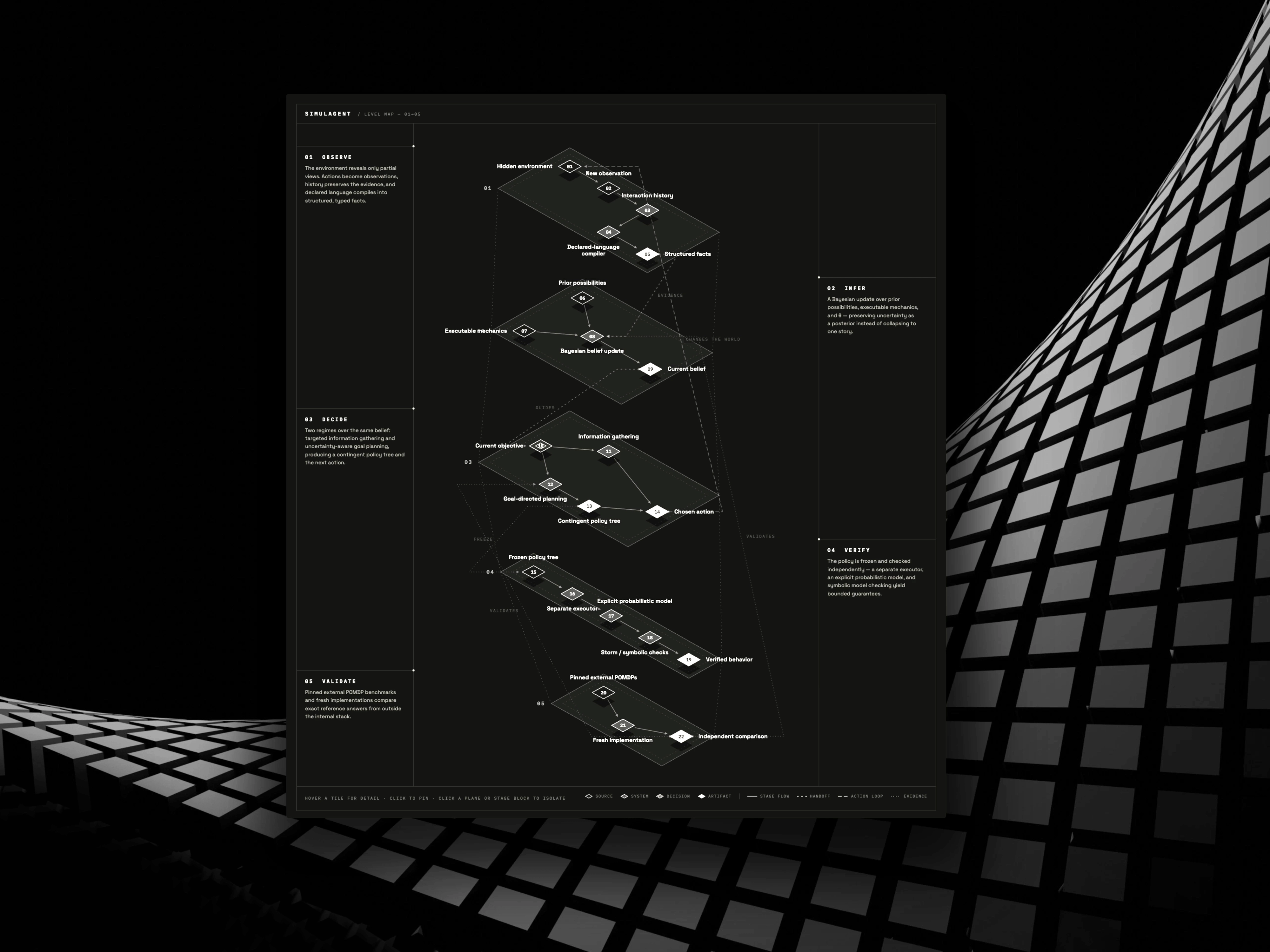
Simulagent system map tracing observation, inference, decision-making, verification, and validation.
Simulagent · System mapFig. 01

My role and motivation

I directed and built the research independently. It began with a broader interest in how agents form a model of the world: what exists, how things relate, and what actions are possible. Simulagent made one part of that question testable by focusing on prediction and adaptation to environmental changes.

How the research developed

  1. Make the question testable

    Build worlds with explicit rules, so the simulation determines what happened independently of the agent’s explanation.

  2. Compare matched situations

    Pair a changed environment with a working control. An agent should respond to the change while still making progress in the control.

  3. Trace the failure

    Compare expected and actual outcomes, then inspect whether a mistake came from prediction, action choice, or recovery.

  4. Revise the experiment

    Test alternatives, audit the evaluation itself, and narrow the claim when the evidence doesn’t support the original idea.

Core Questions

Predict

Does the agent expect the right outcome?

Compare its account of the world with the simulator’s actual transitions.

Act

Does that understanding guide its choice?

A correct written prediction doesn’t necessarily produce a useful action.

Adapt

Does it respond when its assumptions fail?

Inspect whether feedback changes the next decision or simply repeats the same mistake.

A concrete experimental choice

  • I compared working scenarios with ones where progress was blocked, such as a hatch relocking or machinery losing power.

  • These paired situations helped distinguish adaptation from blanket caution. Avoiding every risky action wouldn’t count as understanding the environment.

Following the question further

  • A separate follow-on, Executable Ontology Lab, explored how agents might construct and revise descriptions of a world that could be used for prediction and planning.

  • I paused the broader investigation when progress required additional datasets, independent benchmarks, and external validation. Adapting to entirely novel ontologies remains an open question.

What I take forward

This project taught me to design the evaluation alongside the system. Understanding where an agent fails is often more useful than knowing whether it eventually reached the goal.